
An Invitation to El Naschie’s Theory of Cantorian Space-Time and Dark Energy
Author(s)
Leila Marek-Crnjac, Jihuan He
The paper is a condensed but accurate account of El Naschie’s theory of Cantorian space-time which was used by him to clarify some major problems in theoretical physics and cosmology. In particular El Naschie’s revision and completion of relativity theory and demystification of dark energy are destined to be two milestones in the history of theoretical physics.
KEYWORDS
Cantorian Philosophy; Nonlinear Dynamics and Relativity; Fractal Einstein Gravity; Dark Energy; Ordinary Energy of the Quantum Particle; Dark Energy of the Quantum Wave
Cite this paper
L. Marek-Crnjac and J. He, "An Invitation to El Naschie’s Theory of Cantorian Space-Time and Dark Energy,"International Journal of Astronomy and Astrophysics, Vol. 3 No. 4, 2013, pp. 464-471. doi: 10.4236/ijaa.2013.34053.
| [1] | M. S. El Naschie and I. Prigogine, “Time Symmetry Breaking in Classical and Quantum Mechanics,” Chaos, Solitons & Fractals (Special Issue), Vol. 7, No. 4, 1996, pp. 499-503. |
| [2] | M. S. El Naschie, O. E. R?ssler and I. Prigogine, “Quantum Mechanics, Diffusion and Chaotic Fractals,” Pergamon Press/Elsevier, Oxford, 1995. |
| [3] | J.-H. He, “A Historical Scientific Finding on Dark Energy,” Fractal Space-Time & Non-Commutative Geometry in Quantum & High Energy Phys., Vol. 2, No. 2, 2012, p. 14. |
| [4] | J.-H. He and L. Marek-Crnjac, “Mohamed El Naschie’s revision of Albert Einstein’s E = mc2: A Definite Resolution of the Mystery of the Missing Dark Energy of the Cosmos,” International Journal of Modern Nonlinear Theory and Application, Vol. 2, No. 1, 2013, pp. 55-59. http://dx.doi.org/10.4236/ ijmnta.2013.21006 |
| [5] | L. Marek-Crnjac, “Modification of Einstein’s E = mc2 to E = 1/22 mc2,” American Journal of Modern Physics, Vol. 2, No. 5, 2013, pp. 255-263. |
| [6] | M. S. El Naschie and A. Helal, “Dark Energy Explained via the Hawking-Hartle Quantum Wave and the Topology of Cosmic Crystallography,” International Journal of Astronomy and Astrophysics, Vol. 3, No. 3, 2013, pp. 318-343. |
| [7] | M. S. El Naschie, “The Quantum Gravity Immirzi Parameter—A General Physical and Topological Interpretation,” Gravitation and Cosmology, Vol. 19, No. 3, 2013, pp. 151-155. http://dx.doi.org/ 10.1134/S0202289313030031 |
| [8] | M. S. El Naschie, “What Is the Missing Dark Energy in a Nutshell and the Hawking-Hartle Quantum Wave Collapse,” International Journal of Astronomy and Astrophysics, Vol. 3, No. 3, 2013, pp. 205-211. http://dx.doi.org/10.4236/ijaa.2013.33024 |
| [9] | M. S. El Naschie, “A Resolution of Cosmic Dark Energy via a Quantum Entanglement Relativity Theory,” Journal of Quantum Information Science, Vol. 3, No. 1, 2013, pp. 23-26. http://dx.doi.org/ 10.4236/jqis.2013.31006 |
| [10] | M. S. El Naschie, “Topological-Geometrical and Physical Interpretation of the Dark Energy of the Cosmos as a “Halo” Energy of the Schr?dinger Quantum Wave,” Journal of Modern Physics, Vol. 4, No. 5, 2013, pp. 591-596. http://dx.doi.org/10.4236/jmp.2013.45084 |
| [11] | M. S. El Naschie, “Superstrings, Knots and Non-Commutative Geometry in E-Infinity Space,” International Journal of Theoretical Physics, Vol. 37, No. 12, 1998, pp. 2935-2951. http://dx.doi.org/ 10.1023/A:1026679628582 |
| [12] | M. S. El Naschie, “A Review of E-Infinity and the Mass Spectrum of High Energy Particle Physics,” Chaos, Solitons & Fractals, Vol. 19, No. 1, 2004, pp. 209-236. http://dx.doi.org/10.1016/S0960-0779(03)00278-9 |
| [13] | M. S. El Naschie, “Topological Defects in the Symplictic Vacuum, Anomalous Positron Production and the Gravitational Instanton,” International Journal of Modern Physics E, Vol. 13, No. 4, 2004, pp. 835-849. http://dx.doi.org/10.1142/S0218301304002429 |
| [14] | M. S. El Naschie, “Average Exceptional Lie Group Hierarchy and High Energy Physics,” In: American Institute of Physics (AIP) Conference Proceedings, Vol. 1018, American Institute of Physics (AIP), New York, 2008, pp. 15-20. |
| [15] | P. S. Wesson, “Five-Dimensional Physics,” World Scientific, Singapore, 2006. |
| [16] | P. Weibel, G. Ord and O. Rossler, “Space-Time Physics and Fractality, Festschrift in Honour of Mohamed El Naschie on the Occasion of His 60th Birthday,” Springer, Vienna, New York, 2005. |
| [17] | M. S. El Naschie, “The Theory of Cantorian Space-Time and High Energy Particle Physics (an Informal Review),” Chaos, Solitons & Fractals, Vol. 41, No. 5, 2009, pp. 2635-2646. http://dx.doi.org/10. 1016/j.chaos.2008.09.059 |
| [18] | J.-H. He, “Hilbert Cube Model for Fractal Space-Time,” Chaos, Solitons & Fractals, Vol. 42, No. 5, 2009, pp. 2754-2759. http://dx.doi.org/10.1016/j.chaos.2009.03.182 |
| [19] | J.-H. He, et al., “Twenty-Six Dimensional Polytope and High Energy Space-Time Physics,” Chaos, Solitons & Fractals, Vol. 33, No. 1, 2007, pp. 5-13. http://dx.doi.org/10.1016/j.chaos.2006.10.048 |
| [20] | M. S. El Naschie, “From Classical Gauge Theory Back to Weyl Scaling via E-Infinity Space-Time,” Chaos, Solitons & Fractals, Vol. 38, No. 4, 2008, pp. 980-985. http://dx.doi.org/10.1016/j.chaos. 2008.05.017 |
| [21] | L. Marek-Crnjac, “The Hausdorff Dimension of the Penrose Universe,” Physics Research International, Vol. 2011, 2011, Article ID: 874302. http://dx.doi.org/10.1155/2011/874302 |
| [22] | J.-H. He, et al., “Transfinite Physics—A Collection of Publications on E-Infinity Cantorian Space-Time Theory,” China Culture & Scientific Publishing, Hongkong, 2005. |
| [23] | J.-H. He, E. Goldfain, et al., “Beyond the 2006 Physics Nobel Prize for COBE,” China Culture & Scientific Publishing, Beijing, 2006. |
| [24] | M. S. El Naschie, “Nonlinear Dynamics of the Two-Slit Experiment with Quantum Particles,” Problems of Nonlinear Analysis in Engineering Systems, Vol. 26, No. 2, 2006. |
| [25] | L. Marek-Crnjac, “A Feynman Path Integral-Like Method for Deriving the Four Dimensionality of Space-Time from First Principles,” Chaos, Solitons & Fractals, Vol. 41, No. 5, 2009, pp. 2471-2473. http://dx.doi.org/10.1016/j.chaos.2008.09.014 |
| [26] | M. S. El Naschie, “On ‘tHooft’s Dimensional Regularization in E-Infinity Space,” Chaos, Solitons & Fractals, Vol. 12, No. 5, 2001, pp. 851-858. http://dx.doi.org/10.1016/S0960-0779(00)00138-7 |
| [27] | A. Connes, “Non-Commutative Geometry,” Academic Press, San Diego, 1994. |
| [28] | M. S. El Naschie, “The Missing Dark Energy of the Cosmos from Light Cone Topological Velocity and Scaling the Planck Scale,” Open Journal of Microphysics, Vol. 3, No. 3, 2013, pp. 64-70. http://dx.doi.org/10.4236/ojm.2013.33012 |
| [29] | M. S. El Naschie, “A Note on Quantum Gravity and Cantorian Space-Time,” Chaos, Solitons & Fractals, Vol. 8, No. 1, 1997, pp. 131-133. http://dx.doi.org/10.1016/S0960-0779(96)00128-2 |
| [30] | M. S. El Naschie, “Remarks on Superstrings, Fractal Gravity, Nagasawa’s Diffusion and Cantorian Space-Time,” Chaos, Solitons & Fractals, Vol. 8, No. 11, 1997, pp. 1873-1886. http://dx.doi.org/10.1016/S0960-0779(97)00124-0 |
| [31] | M. S. El Naschie, “Fractal Gravity and Symmetry Breaking in a Hierarchical Cantorian Space,” Chaos, Solitons & Fractals, Vol. 8, No. 11, 1997, pp. 1865-1872. http://dx.doi.org/10.1016/S0960-0779(97) 00039-8 |
| [32] | L. Marek-Crnjac, et al., “Chaotic Fractals at the Root of Relativistic Quantum Physics and Cosmology,” International Journal of Modern Nonlinear Theory and Application, Vol. 2, No. 1A, 2013, pp. 78-88. http://dx.doi.org/10.4236/ijmnta.2013.21A010 |
| [33] | M. S. El Naschie, “Electroweak Connection and Universality of Hardy’s Quantum Entanglement,” Fractal Space-Time & Non-Commutative Geometry in Quantum & High Energy Physics, Vol. 1, No. 1, 2011, pp. 25-30. |
| [34] | M. S. El Naschie, “Fuzzy Multi-Instanton Knots in the Fabric of Space-Time and Dirac’s Vacuum Fluctuation,” Chaos, Solitons & Fractals, Vol. 38, No. 5, 2008, pp. 1260-1268. http://dx.doi.org/10. 1016/j.chaos.2008.07.010 |
| [35] | M. S. El Naschie, “Fuzzy Knot Theory Interpretation of Yang-Mills Instantons and Witten’s 5-Brane Model,” Chaos, Solitons & Fractals, Vol. 38, No. 5, 2008, pp. 1349-1354. http://dx.doi.org/10.1016/j. chaos.2008.07.002 |
| [36] | M. S. El Naschie, “Knots and Exceptional Lie Groups as Building Blocks of High Energy Particle Physics,” Chaos, Solitons & Fractals, Vol. 41, No. 4, 2009, pp. 1799-1803. http://dx.doi.org/10.1016/ j.chaos.2008.07.025 |
| [37] | M. S. El Naschie, “Fuzzy Platonic Spaces as a Model for Quantum Physics,” Mathematical Models, Physical Methods and Simulation in Science & Technology, Vol. 1, No. 1, 2008, pp. 91-101. |
| [38] | M. S. El Naschie, S. Olsen, J. H. He, S. Nada, L. Marek-Crnjac and A. Helal, “On the Need for Fractal Logic in High Energy Quantum Physics,” International Journal of Modern Nonlinear Theory and Application, Vol. 1, No. 3, 2012, pp. 84-92. |
| [39] | M. S. El Naschie, “Quantum Entanglement as a Consequence of a Cantorian Micro Spacetime Geometry,” Journal of Quantum Information Science, Vol. 1, No. 2, 2011, pp. 50-53. http://dx.doi.org/10.4236/jqis.2011.12007 |
| [40] | R. Coldea, D. A. Tennant, E. M. Wheeler, et al., “Quantum Ratio Discovered in a Quantum World,” Science, Vol. 8, No. 32, 2010, pp. 177-180. |
| [41] | M. S. El Naschie, “The Hydrogen Atom Fractal Spectra, the Missing Dark Energy of the Cosmos and Their Hardy Quantum Entanglement,” International Journal of Modern Nonlinear Theory and Application, Vol. 2, No. 3, 2013, pp. 167-169. http://dx.doi.org/10.4236/ijmnta.2013.23023 |
| [42] | M. S. El Naschie, “The Hyperbolic Extension of Sigalotti-Hendi-Sharifzadeh’s Golden Triangle of Special Theory of Relativity and the Nature of Dark Energy,” Journal of Modern Physics, Vol. 4, No. 3, 2013, pp. 354-356. http://dx.doi.org/10.4236/jmp.2013.43049 |
| [43] | M. S. El Naschie, “Dark Energy from Kaluza-Klein Space-Time and Noether’s Theorem via Lagrangian Multiplier Method,” Journal of Modern Physics, Vol. 4, No. 6, 2013, pp. 757-760. http://dx.doi.org/ 10.4236/jmp.2013.46103 |
| [44] | M. S. El Naschie and L. Marek-Crnjac, “Deriving the Exact Percentage of Dark Energy Using a Transfinite Version of Nottale’s Scale Relativity,” International Journal of Modern Nonlinear Theory and Application, Vol. 1, No. 4, 2012, pp. 118-124. http://dx.doi.org/10.4236/ijmnta.2012.14018 |
| [45] | M. S. El Naschie, “Quantum Entanglement: Where Dark Energy and Negative Gravity plus Accelerated Expansion of the Universe Comes from,” Journal of Quantum Information Science, Vol. 3, No. 2, 2013, pp. 57-77. http://dx.doi.org/10.4236/jqis.2013.32011 |
| [46] | M. S. El Naschie, “The Quantum Entanglement behind the Missing Dark Energy,” Journal of Modern Physics and Applications, Vol. 2, No. 1, 2013, pp. 88-96. |
| [47] | M. S. El Naschie, “Determining the Missing Dark Energy of the Cosmos from a Light Cone Exact Relativistic Analysis,” Journal of Physics, Vol. 2, No. 2, 2013, pp. 18-23. |
| [48] | G. Iovane, “Mohamed El Naschie’s E(Infinity) Cantorian Space-Time and Its Consequences in Cosmology,” Chaos, Solitons & Fractals, Vol. 25, No. 3, 2005, pp. 775-779. http://dx.doi.org/10.1016/ j.chaos.2005.02.024 |
| [49] | M. Persinger and C. Lavellee, “Theoretical and Experimental Evidence of Macroscopic Entanglement between Human Brain Activity and Photon Emission,” Journal of Consciousness Exploration & Research, Vol. 1, No. 7, 2010, pp. 785-807. |


 and
 /2)(mc2) where
 is Hardy’s probability of quantum entanglement,
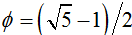
 =(
 - 1)/2 is the Hausdorff dimension of the zero measure thin Cantor set modeling the quantum particle, while the dark energy of the quantum wave is given by E(D) = (5
 /2)(mc2) where
 is the Hausdorff dimension of the positive measure thick empty Cantor set modeling the quantum wave and the factor five (5) is the Kaluza-Klein spacetime dimension to which the measure zero thin Cantor set D(0) = (0,
 ) and the thick empty setD(-1) = (1,
 ) must be lifted to give the five dimensional analogue sets namely
 and 5
 needed for calculating the energy density E(0) and E(D) which together add to Einstein’s maximal total energy densityE(total) = E(0) + E(D) = mc2 = E(Einstein). These results seem to be in complete agreement with the WMAP, supernova and recent Planck cosmic measurement as well as the 2005 quantum gravity experiments of V.V. Nesvizhersky and his associates.
 . A second interesting proposal made in 2012 by Hendi and Sharifzadeh set the critical point at 0.8256645. The present analysis is based upon a light cone velocity quantized coordinate. This leads to the same quantum relativity energy mass relation found in earlier publications by rescaling that of Einstein’s special relativity. Two effective quantum gravity formulae are obtained. The first is for the ordinary measurable energy of the quantum particle
 while the second is for dark energy density of the quantum wave which we cannot measure directly and we can only infer its existence from the measured accelerated expansion of the universe E(D) =
 where
 . The critical velocity parameter in this case arises naturally to be
 . The results so obtained are validated using a heuristic Lorentzian transformation. Finally the entire methodology is put into the wider perspective of a fundamental scaling theory for the Planck scale proposed by G. Gross.